GREEN DRAKE MAYFLY
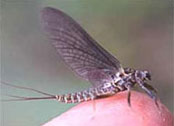
Western Green Drake dun 1
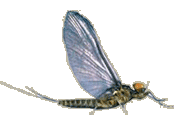
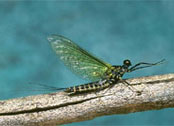
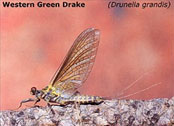
Western Green Drake dun 2
During a certain time of year on our Alberta’s rivers, and in the local fly shops, anglers are often seen scurrying about, mumbling, repeatedly, something about “green drake hatch”, with a wild look in their eyes. For those lucky enough to have been be on stream during this hatch, you likely have had a ‘moment’ in your life. A new addiction may have formed… fishing the green drake hatch!
Green drakes are a large olive mayfly with grey-black segments and a tinge of yellow. The sheer size of the insect, in all stages, nymph, emerger, dun & spinner draws trout’s attention. Only the large stoneflies and the brown drake or possibly the hexagenia mayflies are capable of producing better results – at least on Alberta streams.
In Alberta, size ranges are from an 8 through to #12. An important rule to remember is: the higher elevation you go, the smaller the green drake will be. There is also a tendency for the largest insects to hatch first, with successive batches being somewhat smaller. So early in the hatch size 8 dominate, while at the end of the hatch, about a month after the commencement, the dominant size will be more like a #12.
Fishing the “hatch” may well surprise many people. The most common stages to catch a higher number of fish occurs in either the emergence stage or the spinner stage, or fishing crippled dun patterns. On cooler or cloudy days the emerged dun may float the surface of the water longer, making it a more reliable food source. To hit a hatch on a cloudy, cool day is to find nirvana. However, on warm days the wings dry faster, allowing the dun to fly away more quickly. This generally deters trout from pursuing the dun after spinner falls have begun, as the spent spinners are a large, easy, stationary meal, while quick drying duns tend to fly away.
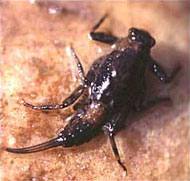
Green drake nymph 1
The green drake nymph is a rather large “crawler”, generally a flatter and wider abdoman than swimmers or burrowing types. The emerging nymph is not a good swimmer and tends to drift helplessly downstream as it rises in the water column. Green drake nymphs frequent rocky, cobbled stream bottoms where the current is somewhat stronger, adding more futility to the swimming efforts of the nymph. Emergence of the green drake generally occurs between 11 am and 3 p.m. in most of Alberta’s mountain streams. One of the best times to be on stream is earlier in the day, drifting nymphs in deeper runs. As the emergence progresses, switch to an emerger. Drifting a floating emerger, or a dun with a dropper green drake emerging nymph to ride about 6 inches below the surface can be especially effective where regulations allow the use of multiple flies.
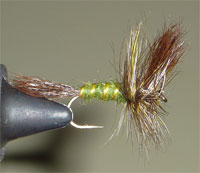
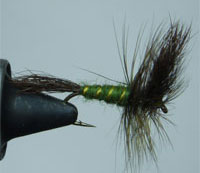
Using green drake cripples, either to represent the emerger or a crippled dun often works – trout will key on drift flies that aren’t likely to be going anywhere as they are easy prey.
The spinner stage of the green drake hatch is also very reliable. Trout will gorge themselves when conditions are right during this spinner fall. It should be noted that trout may choose to feed exclusively on spent spinners.
Fishing the hatch
A 5 or 6 weight rod is most recommended, using a weight forward (WF) or double taper (DT) floating line. Trout are not as wary during this hatch as these are large insects, so that soft presentations aren’t mandatory. Leaders and tippets generally range from a total length of 7 to 10 feet, depending mostly on the current speed of the water. A long slow pool below a riffle requires a longer leader, while a continuous riffle would require a much shorter set up.
Two other items are a must. A net, to land all of the beautiful fish you’ll catch, if you hit it right.
A camera to capture images to remind you of the day is a necessity!.